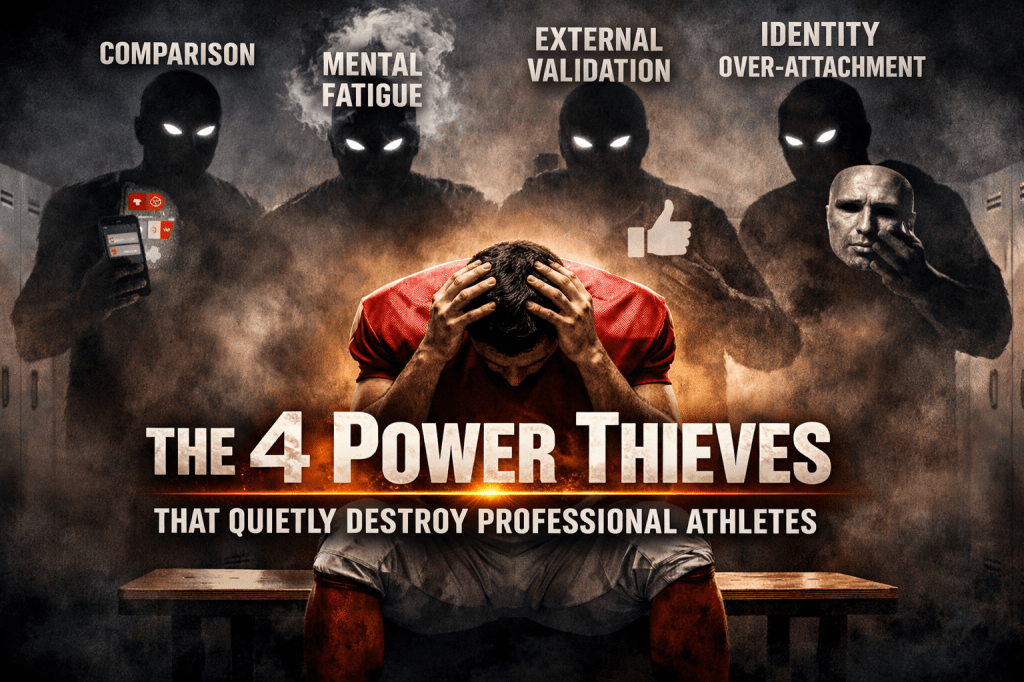
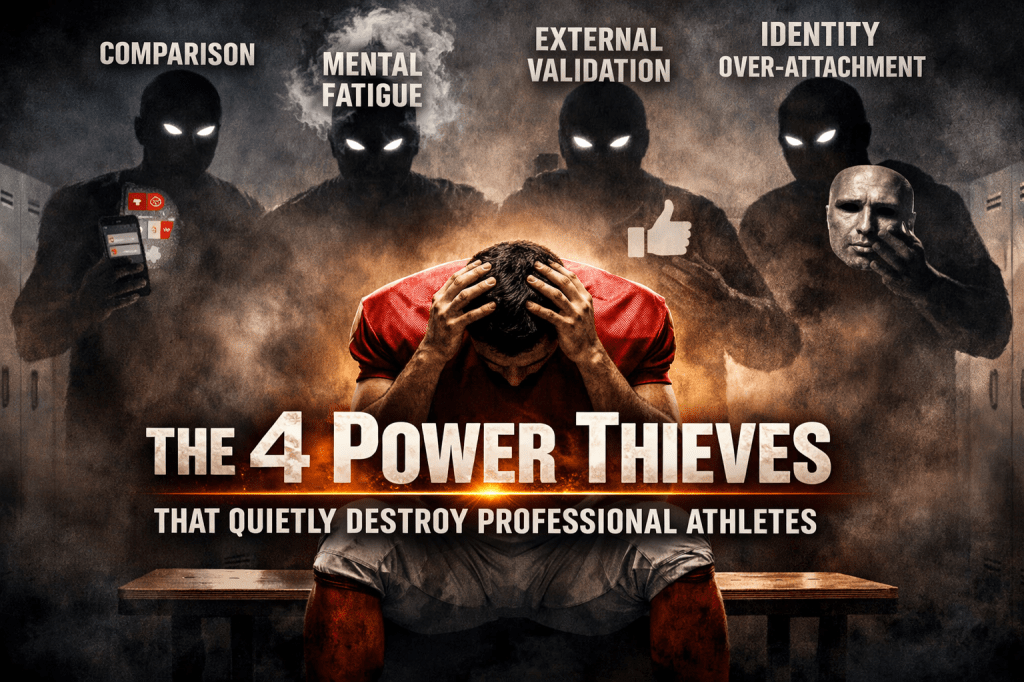
The 4 Power Thieves That Quietly Destroy Professional Athletes
Professional athletes aren’t derailed by a lack of talent or work ethic — they are often undermined by internal psychological dynamics that slowly erode competitive dominance long before physical metrics decline. These dynamics are what I call The 4 Power Thieves.
At elite levels — whether in the National Basketball Association, National Football League, or other global pro arenas — understanding and addressing these subtle performance pressures isn’t optional; it’s foundational.
1. Comparison — The Confidence Leech
Comparison shifts athletes from execution to evaluation.
Athletes fixated on how they stack up — stats, contracts, social media metrics — redirect cognitive resources away from task-focused attention toward self-evaluation. Research in sport psychology shows that confidence, concentration, and mental energy are core components of athletic performance, and fluctuations in these constructs affect well-being and execution under pressure.
When comparison dominates internal narratives:
Execution quality drops Decision-making slows Effort becomes rigid
Top performers treat comparison data as information, not identity.
2. Mental Fatigue — The Invisible Sniper
Mental fatigue isn’t just feeling tired — it’s a measurable depletion of cognitive resources.
A growing body of sport science research links mental fatigue with poorer decision-making, slower reaction times, and reduced performance accuracy. Another study shows that psychological fatigue directly weakens athletes’ response-monitoring systems — the brain networks responsible for anticipating errors and adjusting performance in real time.
In practice, mental fatigue:
Reduces ability to focus under pressure Erodes strategic decision-making Increases psychological stress reactions
Elite athletes guard their cognitive energy as fiercely as their physical durability.
3. External Validation Addiction — The Performance Roller Coaster
When confidence depends on external approval — coach praise, fan applause, social traction — athletes become hostage to feedback.
In sport psychology, performance based self-esteem and overly narrow athletic identity are linked to burnout and emotional exhaustion — both precursors to performance decline. A self-worth framework tied exclusively to outcomes — scores, titles, contracts — creates vulnerability every time performance dips.
Resilient competitors build confidence systems rooted in:
controllables over outcomes process-focused metrics internal definitions of success
4. Identity Over-Attachment — The Psychological Trap
When an athlete’s identity is fused solely with their sport role, even normal competitive fluctuations feel like existential threats.
Sport psychology research on athletic identity highlights a paradox: having a strong athlete identity can support resilience and dedication, but when identity becomes overly fused with performance outcomes, it increases risk for emotional exhaustion and burnout. Another body of literature underscores how rigid performance-based self-worth amplifies psychological stress and undermines optimal performance states.
When this trap sets in:
Fear enters competition Self-esteem fluctuates with performance Risk tolerance shrinks
High performers maintain a stable self-concept that extends beyond the scoreboard.
The Science Is Clear: Performance Is Psychological
Across peer-reviewed sport science and performance psychology research, certain constants emerge:
Cognitive and emotional energy affect execution and decision-making. Confidence and motivation are psychological constructs that enhance performance when well-regulated. Identity dynamics influence stress reaction and burnout risk.
Peak performance isn’t just about physical capacity — it’s about mental architecture.
Coach & Organizational Implications
Top talent development teams are now measured by:
Their ability to cultivate psychological resilience Their systems for mental energy management Their frameworks for internal confidence stabilization Their strategies for adaptive athlete identity development
Because the athlete who guards their psychological power lasts longer, performs more consistently, and competes with dominance — even under pressure.
If you work with elite athletes and are committed to building durable performance systems, let’s connect.
Physical skill wins games — psychological mastery sustains legacies.

Leave a comment